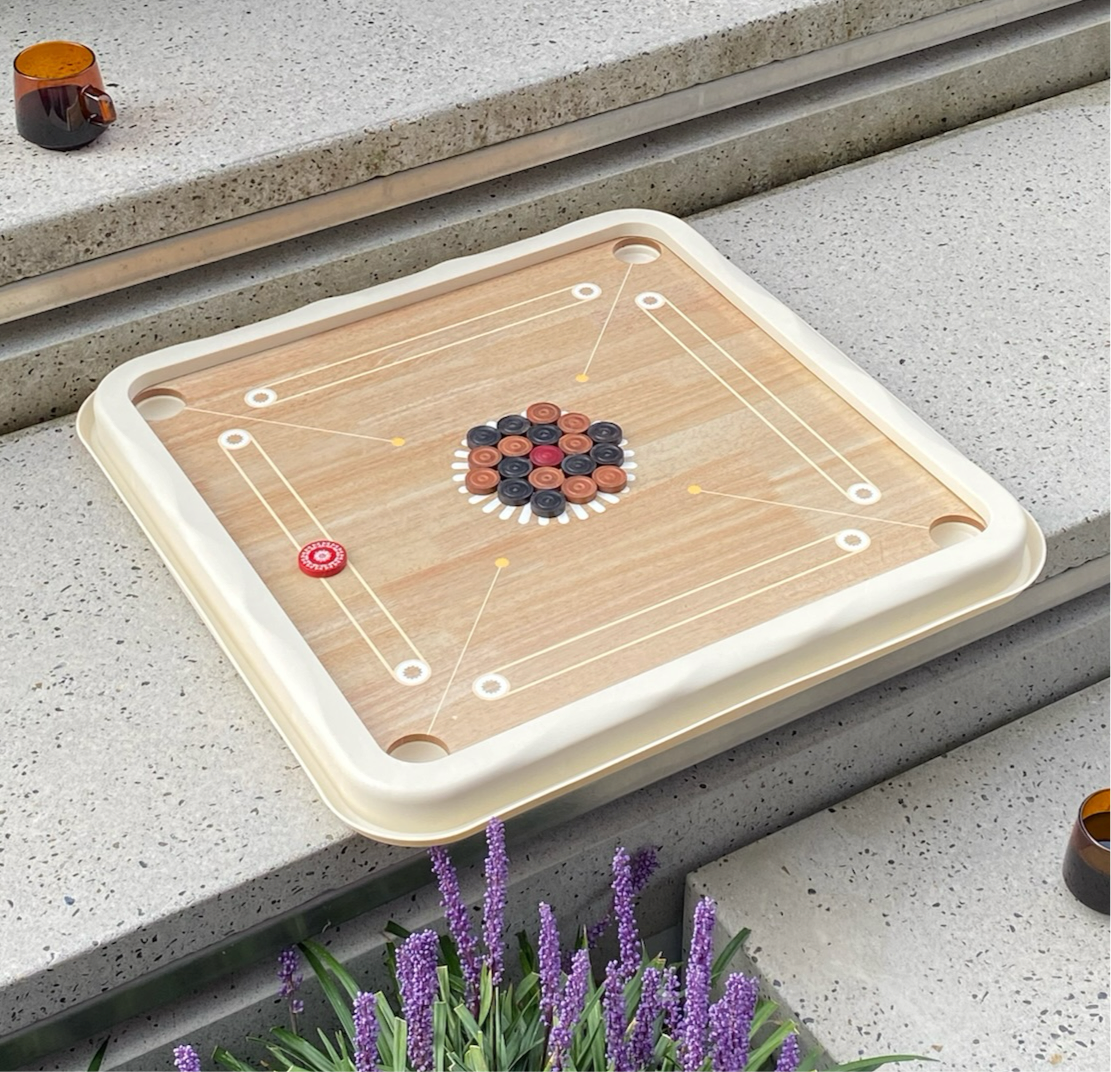

Carrom Quick Reference at a Glance
- Players: 2 (Singles: 1v1) or 4 (Doubles: 2v2)
- Game Objective: Pocket all of your assigned Carrom men before your opponent and successfully "cover" the Queen.
- Match Duration: 20 to 45 minutes (played across multiple boards up to 21 or 25 points)
- The Pieces: 9 White coins, 9 Black coins, 1 Red Queen, 1 Acrylic Striker
- Governing Body: International Carrom Federation (ICF)
1. Understanding the Equipment & Board Anatomy
Before taking your opening shot, it helps to understand the anatomy of a regulation Carrom board. A standard board consists of a smooth, flat square playing surface framed by solid wooden rebound rails with four circular corner pockets lined with woven catch nets.
The Essential Pieces:
- Carrom Men (Pieces / Coins): A regulation set includes 19 smooth circular wooden discs: 9 White (Light) coins, 9 Black (Dark) coins, and 1 Red Queen. White pieces are traditionally assigned to the player who breaks.
- The Striker: A heavier, smooth acrylic or resin disc (up to 15 grams in ICF tournament play) that each player flicks with their fingers to propel the Carrom men into the corner pockets.
- The Red Queen: The single most valuable piece on the board. The Queen is worth 3 bonus points in standard play, but pocketing her requires you to immediately "cover" her with one of your own coins.
- Carrom Powder: Specially formulated super-fine powder (traditionally boric acid powder or modern microscopic microsphere disco powder) dusted lightly across the surface to reduce friction, allowing the striker and coins to glide effortlessly.
Key Board Markings:
- Center Circle & Concentric Circles: The circular target zone in the exact middle of the board where all 19 pieces are stacked before the opening break.
- Baselines (The Flicking Line): Two parallel lines on each side of the board. The area between these lines is where each player must place the striker during their turn.
- Base Circles (Cut Circles): The red circles located at either end of your baseline. The striker must either entirely cover one of these circles or avoid touching it altogether.
- Arrow Lines: Diagonal boundary lines extending toward each pocket that mark foul zones and guide visual aim.

Play Carrom Official 24" Board Game
Crafted for smooth glides and crisp rebounds. Features a premium satin-finished playing surface, durable solid wood borders, and includes full coins, striker, and powder.
2. How to Set Up the Carrom Board (The Classic Arrangement)
Setting up the board properly ensures fair play and true breaks. The coins are always clustered inside the center circle in a traditional concentric pattern:
- Place the Queen Dead Center: Set the red Queen flat on the red center spot of the board.
- Form the Inner Ring (6 Coins): Encircle the Queen with 6 alternating coins (3 White and 3 Black). Arrange them in a tight circle so each coin touches the Queen and its two neighboring coins.
- Form the Outer Ring (12 Coins): Encircle the inner ring with the remaining 12 coins, strictly alternating White and Black coins. When correctly positioned, the cluster forms a compact, symmetrical circular honeycomb pattern where every coin is touching.
- Orientation Check: Ensure that the White pieces in the outer ring point symmetrically toward the corner pockets. The entire cluster must fit neatly inside the outer concentric boundary circle of the center court.
- Apply Powder: Sprinkle a pinch of carrom powder evenly across the playing surface. Run your hand or striker across the wood to distribute a micro-thin, silky layer.
3. Gripping & Flicking: Master Your Shooting Mechanics
Unlike billiards where you use a cue stick, in Carrom your fingers are your weapon. Developing a smooth, consistent flick makes the difference between erratic bounces and pocketing on demand.
The Middle Finger Flick (Most Common & Powerful)
Rest the heel of your palm firmly on the wooden frame or the playing board just behind your baseline. Curl your middle finger against your thumb to build tension. Release the finger cleanly forward in a snapping motion directly into the center of the striker. This flick provides maximum power for break shots and long drives.
The Index Finger Flick (Precision & Finesse)
Place your palm on the board, resting your thumb behind your index finger. Cock your index finger back and snap it forward into the striker. This grip offers superior directional control and touch for delicate cut shots and tight bank angles.
The Thumb Flick (Backward & Close-Angle Shots)
Anchor your knuckles or palm on the frame. Tuck your thumb behind your curved fingers and flick the thumb forward or outward. The thumb flick is invaluable for striking coins positioned close to your baseline or shooting rebound shots off the back rail.
4. Starting the Match & The Opening Break
Before the game begins, players determine colors and shooting order. In casual play, a quick coin toss or hiding a white coin in one hand will do. In official ICF tournament play, the player who breaks always shoots White, and the defender plays Black.
Baseline Positioning Rules:
- When placing your striker on your baseline, it must touch both the front and back baseline rails simultaneously.
- The striker must either completely cover the red base circle at either end of your line, or must not touch it at all. Partial overlapping of the red circle is an immediate placement foul.
- Your body, elbows, and feet must stay strictly on your side of the board. You cannot reposition your chair or lean around the board to get an easier angle.
The Break Shot:
The breaking player positions the striker on their baseline and delivers a powerful forward flick into the center cluster.
- If the breaker pockets any White pieces on the break, they retain their turn and continue shooting from the baseline.
- If a Black piece is accidentally pocketed on the break, it remains pocketed for the defender, and the breaker's turn ends unless a White piece was pocketed on the very same stroke.
- If no pieces are pocketed, the turn passes clockwise to the next player.

Official Carrom Essentials Kit
Upgrade your table with tournament-grade equipment. Includes 24 handcrafted wooden carrom men (White, Black & Queen), a precision 14.7g tournament striker, and high-performance friction-reducing powder.
5. The Queen: Pocketing & "Covering" (The Most Critical Rule)
The red Queen is the crown jewel of Carrom. However, pocketing the Queen alone does not award her to you; she must be properly covered to count.
The Three Golden Rules of the Queen:
- Eligibility to Pocket: You may pocket the Queen at any point during the game, provided you have already pocketed at least one piece of your own color, or as long as you still have remaining pieces on the board to cover her with. You cannot pocket the Queen as your very first shot of the game before any coin has been cleared in official ICF play.
- The Cover Shot: When you successfully sink the Queen into any pocket, your turn continues immediately. You must pocket one of your own assigned coins (White or Black) on the very next stroke. This subsequent piece is called the "Cover."
-
Successful vs. Failed Cover:
- Successful Cover: If you sink your piece on that next stroke, congratulations! The Queen is officially covered and yours. You keep the Queen in your pocket tray, and your turn continues.
- Failed Cover: If you miss the shot and fail to pocket your piece, the Queen is not covered. The Queen is immediately returned to the exact center circle of the board by the umpire or opponent, and your turn ends.
6. Fouls, Penalties & The "Due" System
Fouls add tactical tension to Carrom. When a player commits a foul, their turn ends immediately, and they are assessed a penalty piece known as a "Due".
| Foul Violation | Penalty / Consequence | Piece Placement |
|---|---|---|
| Pocketing the Striker (Scratch) | Turn ends immediately + 1 penalty coin ("Due") returned to board. | Opponent places 1 of your previously pocketed coins in the center circle. |
| Pocketing Striker + Your Own Coin | Turn ends + 1 penalty coin. The pocketed coin also returns. | Both coins (pocketed + penalty) are placed back inside the center circle. |
| Pocketing Striker + The Queen | Turn ends. The Queen and 1 penalty coin return to center. | Queen sits on red center spot; penalty coin placed adjacent. |
| Striker Flies Off the Board | Turn ends immediately. No additional coin penalty unless striker also touched an active pocket. | Striker returned to player for their next turn. |
| Improper Baseline Placement | Foul called. Shot canceled or turn forfeited if struck before correction. | Opponent takes over turn from their baseline. |
| Touching In-Play Coins with Hands | 1 penalty coin ("Due") assessed + turn ends immediately. | Penalty coin placed in the center circle by the opponent. |
7. Scoring System & Winning Conditions
A Carrom board ends as soon as either player pockets the last piece of their color from the board. Here is how points are calculated:
Calculating the Board Score:
- Base Points: The winner receives 1 point for every remaining coin of the opponent's color left sitting on the board. For example, if you pocket all 9 of your White pieces and your opponent still has 4 Black pieces on the board, you score 4 points.
- The Queen Bonus: If the winner of the board also successfully pocketed and covered the Queen during that frame, they earn an additional 3 bonus points. If the losing player covered the Queen earlier, neither player receives the 3 bonus points.
- The 21-Point Rule (Official ICF Standard): Once a player reaches a total cumulative score of 21 points in a match, they no longer receive the 3 bonus points for the Queen in subsequent boards. Only the base points from the opponent's remaining pieces are counted.
- Match Victory: A match is typically won by the first player or doubles team to reach 21 or 25 points, or whoever holds the highest total score after 8 completed boards.
8. 5 Expert Tips to Instantly Elevate Your Game
1. Anchor Your Pivot Hand
Inconsistent shots happen when your wrist wobbles. Rest the heel of your palm firmly on the wooden frame rail. This creates a rock-solid fulcrum that makes aiming feel intuitive.
2. Master the Rebound (Bank Shot)
Direct shots are not always open. Learn to use the hardwood borders to rebound your striker at 45-degree angles to hit tucked pieces from behind.
3. Don't Over-Powder the Board
Too much carrom powder creates clumps that deflect coins unpredictably. A light, barely visible dusting provides the optimal glide ratio.
4. Play Tactical Defense
If you don't have a clean pocket shot, don't just blast the board. Gently nudge your opponent's pieces into awkward spots along the border rails where they are hardest to sink.
5. Time Your Queen Attack
Never rush to pocket the Queen unless you have an easy, high-percentage cover shot ready to go on the very next stroke.
9. Frequently Asked Questions (FAQ)
Can you flick backwards in Carrom?
Yes. Under official International Carrom Federation rules and standard house play, you may strike backward toward your own baseline as long as you use an approved flicking technique (such as a clean thumb flick or backward finger flick) and do not violate baseline positioning rules.
What happens if the Queen and a coin are pocketed together?
If you strike the Queen and sink both the Queen and one of your own assigned coins on the exact same stroke, the Queen is counted as covered immediately! Your turn continues. If you sink the Queen and an opponent's coin on the same shot, the Queen returns to the center, the opponent's coin stays pocketed, and your turn ends.
What is the penalty for pocketing the striker on the break shot?
Pocketing the striker on the break is a foul. Your turn ends immediately, and one penalty coin ("Due") must be placed back in the center circle. If you have not yet pocketed any pieces, an outstanding due is owed as soon as you sink your first coin.
What is the difference between boric powder and disco powder?
Boric acid powder is the traditional, smooth vegetable-based powder that allows consistent, moderate glide without airborne dust. Disco powder (often made of microspheres) produces an ultra-fast, almost frictionless surface favored by advanced tournament players for high-speed bank shots.
How do you determine who goes first in Carrom?
Players typically toss a coin or hide a white coin in one hand while the opponent guesses. The winner of the toss chooses either to break first (playing White) or to choose their preferred seating side.
Can a game end if the Queen is still on the board?
Under official rules, the Queen must be pocketed and covered before the board can conclude. If a player pockets all of their assigned coins while the Queen is still in play, that player forfeits the Queen bonus, and specific penalty/re-rack rules apply depending on tournament standards.
Continue Your Carrom Journey
Explore our beginner tutorials, board craftsmanship guides, and historical archives: